PUSHERS Volume I by Terrence Murphy
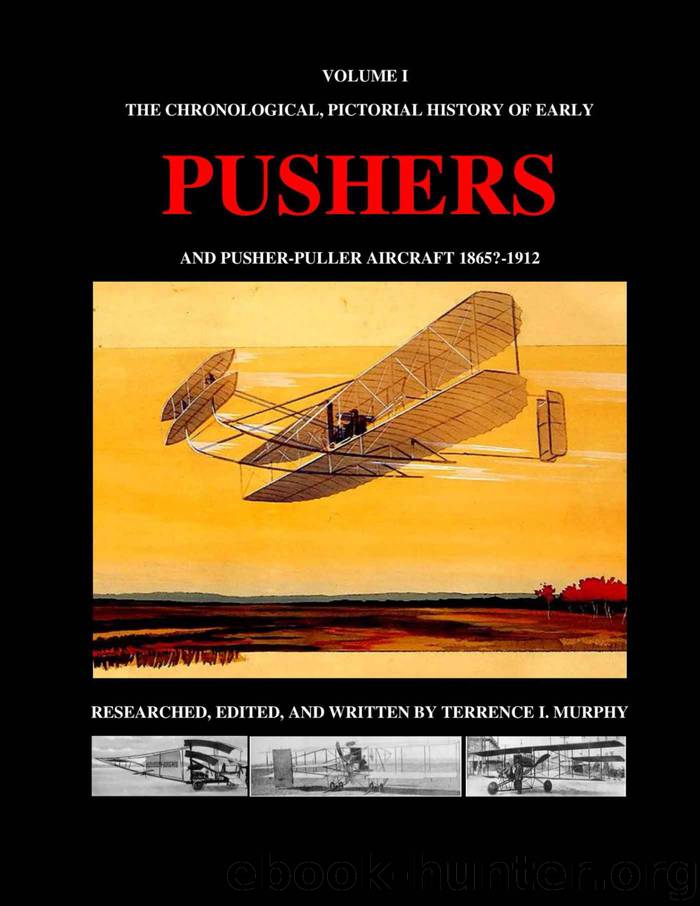
Author:Terrence Murphy [Murphy, Terrence]
Language: eng
Format: azw3
Publisher: UNKNOWN
Published: 2018-11-22T16:00:00+00:00
AVITOR POEM
(An Aerial Retrospect)
What was it filled my youthful dreams, In place of Greek or Latin themes, Or beauty's wild, bewildering beams?
Avitor! What visions and celestial scenes I filled with aerial machines, Montgolfier's and Mr. Green's!
Avitor! What fairy tales seemed things of course! The roc that brought Sindbad across, The Calendar's own winged horse!
Avitor! How many things I took for facts, Icarus and his conduct lax, And how he sealed his fate with wax!
Avitor! The first balloons I sought to sail, Soap-bubbles fair, but all too frail, Or kites,--but thereby hangs a tail.
Avitor! What made me launch from attic tall A kitten and a parasol,
And watch their bitter, frightful fall? Avitor!
What youthful dreams of high renown Bade me inflate the parson's gown,
That went not up, nor yet came down? Avitor!
My first ascent I may not tell;
Enough to know that in that well My first high aspirations fell. Avitor!
My other failures let me pass: The dire explosions, and, alas! The friends I choked with noxious gas.
Avitor! For lo! I see perfected rise The vision of my boyish eyes, The messenger of upper skies.
Avitor!
- Bret Harte, winner, San Francisco News Letter poetry contest, 1869
SIMPLE GLOSSARY OF AERONAUTICAL TERMS 1912 Aerodrome —Literally, a machine that runs in the air. Aerofoil. —The advancing transverse section of an aeroplane.
Aeroplane—A flying machine of the glider pattern, used in contra-distinction to a dirigible balloon. Aeronaut—A person who travels in the air.
Aerostat—A machine sustaining weight in the air. A balloon is an aerostat.
Aerostatic—Pertaining to suspension in the air; the art of aerial navigation.
Ailerons—Small stabilizing planes attached to the main planes to assist in preserving equilibrium. Angle of Incidence—Angle formed by making comparison with a perpendicular line or body. Angle of Inclination—Angle at which a flying machine rises. This angle, like that of incidence, is obtained by comparison with an upright, or perpendicular line.
Auxiliary Planes—Minor plane surfaces, used in conjunction with the main planes for stabilizing purposes.
Biplane—A flying-machine of the glider type with two surface planes.
Blade Twist—The angle of twist or curvature on a propeller blade.
Cambered—Curve or arch in plane, or wing from port to starboard.
Chassis—The under framework of a flying machine; the framework of the lower plane. Control—System by which the rudders and stabilizing planes are manipulated.
Dihedral—Having two sides and set at an angle, like dihedral planes, or dihedral propeller blades. Dirigible—Obedient to a rudder; something that may be steered or directed.
Helicopter—Flying machine the lifting power of which is furnished by vertical propellers. Lateral Curvature—Parabolic form in a transverse direction.
Lateral Equilibrium or Stability—Maintenance of the machine on an even keel transversely. If the lateral equilibrium is perfect the extreme ends of the machine will be on a dead level.
Longitudinal Equilibrium or Stability—Maintenance of the machine on an even keel from front to rear. Monoplane—Flying machine with one supporting, or surface plane.
Multiplane—Flying machine with more than three surface planes.
Ornithopter—Flying machine with movable bird-like wings.
Parabolic Curves—Having the form of a parabola—a conic section.
Pitch of Propeller Blade—See "Twist."
Ribs—The pieces over which the cloth covering is stretched.
Spread—The distance from end to end of the main surface; the transverse dimension.
Download
This site does not store any files on its server. We only index and link to content provided by other sites. Please contact the content providers to delete copyright contents if any and email us, we'll remove relevant links or contents immediately.
Whiskies Galore by Ian Buxton(42082)
Introduction to Aircraft Design (Cambridge Aerospace Series) by John P. Fielding(33175)
Small Unmanned Fixed-wing Aircraft Design by Andrew J. Keane Andras Sobester James P. Scanlan & András Sóbester & James P. Scanlan(32835)
Aircraft Design of WWII: A Sketchbook by Lockheed Aircraft Corporation(32333)
Craft Beer for the Homebrewer by Michael Agnew(18287)
Turbulence by E. J. Noyes(8113)
The Complete Stick Figure Physics Tutorials by Allen Sarah(7424)
The Institute by Stephen King(7093)
The Thirst by Nesbo Jo(7002)
Kaplan MCAT General Chemistry Review by Kaplan(6989)
Bad Blood by John Carreyrou(6671)
Modelling of Convective Heat and Mass Transfer in Rotating Flows by Igor V. Shevchuk(6495)
Weapons of Math Destruction by Cathy O'Neil(6363)
Learning SQL by Alan Beaulieu(6345)
Man-made Catastrophes and Risk Information Concealment by Dmitry Chernov & Didier Sornette(6138)
Permanent Record by Edward Snowden(5892)
Digital Minimalism by Cal Newport;(5835)
Life 3.0: Being Human in the Age of Artificial Intelligence by Tegmark Max(5618)
iGen by Jean M. Twenge(5454)
